The destruction of cultural heritage during armed conflicts is not a new phenomenon. However, the Ukrainian case raises a crucial question:
Are these acts the consequence of warfare, or do they reflect a more structured strategy of cultural domination?
This question becomes particularly relevant when practices of cultural appropriation and relocation are observed not only during active hostilities, but also in periods preceding large-scale military escalation.
The ongoing war is highly complex, and so is the phenomenon of Russification, a historical term used to describe processes of cultural assimilation in which non-Russian populations are encouraged or compelled to adopt Russian language, culture, and identity. Historians have used this concept to analyze policies implemented during the Russian Empire and the Soviet Union, often in connection with political centralization rather than cultural exchange. Historically, Russification has affected multiple dimensions of cultural life, including language, education, architecture, religion, artistic production, and the symbolic transformation of public space. Scholars commonly distinguish between the spread of Russian language or culture (Russianization) and deeper processes of identity transformation and assimilation (Russification).
In contemporary contexts, these dynamics re-emerge explicitly. Russian state narratives have repeatedly denied Ukraine’s cultural and historical autonomy, framing Russians, Ukrainians, and Belarusians as “one single people”, and portraying Ukrainian statehood as artificial (Putin, 2021). Several official statements have framed cultural heritage as a strategic target, linking military objectives to the destruction of identity, history, and public memory. Concerns about the nature of cultural damage have also been raised at the international level. The United Nations (2023), UNESCO, and the Council of Europe (2024) have described the destruction and looting of Ukrainian cultural heritage as potentially systematic and deliberate.
Attacks against cultural heritage sites are prohibited under international law, notably the 1954 Hague Convention for the Protection of Cultural Property in the Event of Armed Conflict. Within this legal framework, international organizations have accused Russian forces of deliberately targeting Ukrainian cultural heritage, with more than 1,000 cultural sites reportedly damaged by bombardment. At the same time, cultural and political dynamics are rarely unidirectional or unambiguous. For this reason, this project does not frame the phenomenon in binary terms, but instead investigates what patterns in data can, and cannot, reveal.
The project integrates multiple institutional datasets that document different dimensions of cultural harm in Ukraine. Rather than relying on a single source, we combined data on looted objects, damaged cultural sites, artists, museum collections, conflict events, and heritage protection lists. Each dataset captures a specific aspect of the phenomenon. Together, they allow us to analyze how destruction, looting, cultural appropriation, and violence interact across time, space, and institutional contexts.
This dataset documents cases of cultural property expropriation recorded in the official Ukrainian War Sanctions Registry. It includes detailed records of stolen objects such as paintings, archaeological artifacts, liturgical items, and decorative arts, with information on provenance, location of theft, and date of the incident. It serves as the primary source for analyzing patterns of cultural looting during the conflict.
This dataset is based on UNESCO's official assessments of cultural sites damaged or destroyed since the beginning of the conflict. It includes verified records of attacks on monuments, museums, religious buildings, and historic urban areas, with standardized geographic and temporal information. The dataset provides an institutional overview of cultural destruction in Ukraine.
The Linked4Resilience dataset refines UNESCO damage reports by applying strict criteria of name disambiguation, geospatial verifiability, and location stability, combined with semantic enrichment through external open sources. From the original UNESCO records, only sites that can be uniquely identified and reliably geolocated are retained and harmonized within a knowledge graph structure.
This dataset combines two UNESCO inventories related to heritage protection in Ukraine: World Heritage Sites and sites included in the Tentative List. It was used to contextualize damaged sites within international protection frameworks and to assess whether designated or candidate sites were disproportionately affected. The dataset provides a reference layer for evaluating the role of heritage status.
The Armed Conflict Location & Event Data Project (ACLED) provides georeferenced records of political violence in Ukraine from 2014 to 2024. The dataset includes information on battles, remote violence, violence against civilians, and strategic developments. It was used to contextualize cultural damage and looting within broader patterns of military activity and territorial control.
This dataset originates from an open data initiative by Texty.org.ua that archived collection inventories from major Russian museums, including the Hermitage, prior to 2014. The records document cultural objects with Ukrainian provenance that were later removed from official museum websites. The dataset was used to explore long-term patterns of cultural appropriation through institutional collections.
The ICOM Red List of Ukraine is an emergency reference tool developed by the International Council of Museums. It identifies categories of Ukrainian cultural objects that are particularly vulnerable to theft, illicit trafficking, and looting during armed conflict. Rather than documenting individual incidents, the Red List provides typological guidance to support prevention, monitoring, and protection efforts, and was used in this project as a contextual framework for interpreting patterns of cultural risk.
This dataset was constructed through SPARQL queries to the Wikidata knowledge base. It includes structured metadata on Ukrainian artists, such as birthplaces, life dates, institutional affiliations, and historical periods. The dataset enables semantic linking between artists, places, movements, and other cultural entities.
Throughout its history, Ukraine has been shaped by continuous political instability and long periods of foreign domination. From the medieval state of Kievan Rus’, centered in Kyiv between the ninth and eleventh centuries, the region played a key political and cultural role in Eastern Europe. However, internal divisions and the Mongol invasions of the thirteenth century led to the collapse of this early state. After that, Ukrainian territories were gradually controlled by different powers, including the Grand Duchy of Lithuania, the Polish–Lithuanian Commonwealth, the Crimean Khanate, the Ottoman Empire, the Habsburg monarchy, the Russian Empire, and later the Soviet Union. These constant changes in political control greatly delayed Ukraine’s path to independence and weakened the development of stable cultural institutions.
This complex historical background had a direct impact on Ukrainian cultural heritage. Cultural life was largely managed from imperial centers, while local institutions were limited or dismantled. Although there were moments of partial autonomy, such as the Cossack Hetmanate in the seventeenth century, these periods were short-lived and eventually suppressed, especially after Ukraine’s incorporation into the Russian Empire in the late eighteenth century. Policies restricting the Ukrainian language and identity, together with the centralization of archives, artworks, and religious objects in cities like Moscow and St. Petersburg, turned cultural dispossession into a long-term and systematic process rather than an isolated consequence of war.
The twentieth century further intensified these dynamics. After brief attempts to establish an independent state following the First World War, most Ukrainian territory became part of the Soviet Union. During this period, political repression, forced famine, and centralized cultural policies caused severe damage to Ukrainian heritage. The Second World War led to particularly heavy losses, including hundreds of thousands of museum objects, millions of books, and thousands of religious artifacts. Although international agreements, such as the 1954 Hague Convention, were created to protect cultural property during armed conflict, their enforcement in the Ukrainian case remained weak and often influenced by political interests.
Ukraine achieved internationally recognized independence only in 1991, much later than many other European countries. This late independence helps explain why the protection and restitution of Ukrainian cultural heritage remain unresolved issues today. Despite the existence of international treaties designed to prevent cultural looting and destruction, meaningful restitution has been limited. The ongoing conflict, intensified by the full-scale Russian invasion of 2022, shows that cultural heritage is not only a historical concern but a central element of contemporary geopolitical struggles. Understanding Ukraine’s long and complex history is therefore essential to grasp both the scale of its cultural losses and the challenges involved in addressing them.
This project does not aim to take a political position. Instead, it adopts a data-driven and exploratory approach, focusing on the documentation and analysis of verified sources. We integrated and cross-referenced multiple datasets related to: damaged and destroyed cultural sites, looted cultural objects, conflict and invasion events, museum collections and artist databases.
A central part of our work consisted in monitoring, cleaning, reconciling, and aligning institutional data produced by organizations with different mandates, update rhythms, and documentation standards.
By putting these heterogeneous sources into dialogue, the project proposes a methodological contribution to the study of cultural heritage destruction in contemporary conflicts. More broadly, it highlights the importance of institutional data monitoring and of cross-dataset integration as tools to communicate and investigate complex phenomena such as war, cultural loss, and imperial dynamics.
To translate these concerns into a data-driven investigation, we formulated research questions focused on observable patterns in cultural destruction and looting. Using institutional datasets, we examine when, where, and how different forms of cultural harm occur, without assuming intent or causality.
Historical Dispersion: Ukrainian Heritage in Russian Museums
This analysis examines the systematic removal and displacement of Ukrainian cultural heritage over centuries of foreign rule, focusing on the Russian Empire and Soviet Union. By analyzing a dataset of 14,508 artifacts from Ukraine currently held by the State Hermitage Museum in St. Petersburg, we quantify the extent of this cultural dispersion and explore the legal complexities of restitution in the face of neo-colonial narratives. The study addresses three core questions:
Sub-questions
- 1. What are the temporal patterns of artifact extraction across historical periods?
- 2. Which Ukrainian regions were most affected by cultural displacement?
- 3. What types of material culture were systematically removed?
- 3. How types of material culture were systematically removed?
The scale of cultural loss is staggering. Historian Serhiy Kot notes that during WWII alone, Ukraine lost up to 250,000 items from museums and 50 million books. Items taken from Ukraine accounted for 55% of all cultural objects lost by the Soviet Union during the war. While restitution processes are widespread globally, the situation between Ukraine and Russia remains uniquely complex due to political discourse denying Ukraine's distinct historical existence.
14,508 Ukrainian artifacts from 33,391 objects in the Hermitage
To understand the magnitude of cultural dispersion, we analyzed the State Hermitage Museum collection in St. Petersburg. The original dataset contained 33,391 objects from various regions. We filtered this to identify items of Ukrainian origin, resulting in 14,508 artifacts—representing 43.5% of the entire collection.
Data cleaning involved translating Cyrillic text to English, standardizing irregular date formats (from millennia to specific years), reconciling geolocation data with contemporary Ukrainian regions, and categorizing materials into broader taxonomies. Each object was assigned to a historical period to visualize chronological patterns of acquisition across centuries.
Temporal patterns: Phases of systematic extraction
The timeline reveals four distinct phases of cultural extraction. During the Russian Empire (1848–1917), centralist policies dictated that valuable artifacts be sent to imperial capitals, with 235 objects acquired. When Kyiv intellectuals proposed a local museum in 1888, the Governor-General rejected it as "unnecessary."
The First Independence period (1917–1921) saw 1,691 objects acquired during territorial conflict. The lack of formal records suggests many were looted. The Soviet Era (1922–1991) represents the peak: 7,908 objects acquired, with the highest surge between 1960-1980 when "union-wide significance" policies automatically sent valuable finds to Russia.
As can be observed, more than half of the objects (54.52%) were acquired during the Soviet period, making this the time of greatest spoliation of Ukrainian cultural heritage.
Soviet Era (1922–1991)
The Soviet period represents the peak of systematic extraction. Serhiy Kot writes that between 1918 and 1923, the Bolsheviks seized at least 10 million objects worth 10 billion rubles (in 1913 prices). In Kyiv alone, 150 private collections containing 200,000 objects were seized in 1922.
Why was the Soviet period particularly intense in terms of looting? Beyond the evident justification of political domination over the territory, Soviet authorities developed a series of protective, administrative, and ideological arguments to legitimize the acquisition and transfer of Ukrainian cultural heritage. Under these pretexts, historical patrimony was systematically removed from Ukraine and relocated to Russia through various mechanisms
Looting mechanisms included:
- 1. Export for Sale: In the 1920s and 30s, artifacts were sold abroad to fund state revenue.
- 2. Archaeological Boom: Valuable archaeological finds were automatically deemed of "union-wide significance" and sent to Russia.
- 3. Exhibitions: Items sent to Moscow for exhibitions were frequently "misplaced" or absorbed into Russian collections.
- 4. Museum seizures
- 5. Religious confiscations
The Dilemma of Colonialism
The removal of cultural artifacts from Ukraine reveals a persistent dilemma. On one hand, the transfer of artifacts to Moscow and Saint Petersburg by the Russian imperial authorities safeguarded them, protecting them from theft or dispersal into private collections. On the other hand, Ukrainian initiatives to establish local museums and conduct scientific research were systematically obstructed. For example, state funding to acquire valuable finds from local illegal excavators was granted exclusively to Russian museums.
Ukrainian scholars, museum professionals, and prominent philanthropists frequently acted as intermediaries, negotiating between local sellers and museums in Moscow and Saint Petersburg and advocating for the acquisition of Ukrainian artifacts.
A notable case involves the philanthropist Bohdan Khanenko, who tried to convince the Hermitage Museum to purchase a rectangular gold plaque adorned with an emerald, unearthed in Poltava Oblast. His efforts were unsuccessful, and the artifact was ultimately lost, illustrating both the constraints placed on Ukrainian cultural actors and the broader mechanisms of imperial control over heritage.
Surprisingly, even after Independence (1991–2015), 813 objects were acquired, indicating continued outflow through black market channels. The Soviet period employed multiple extraction mechanisms: artifacts were sold abroad for state revenue, archaeological finds were deemed "union-wide," items sent for exhibitions were "misplaced," and religious confiscations were systematic.
These cases raise critical questions regarding the legal frameworks and oversight governing archaeological excavations and export permits during both the late Soviet and post-independence periods, including whether such items were acquired through authorized scientific excavation and proper documentation, or trafficked through looters and informal markets.
While some artifacts may have been legally documented at the time of excavation, the provenance of many remains unclear or contested, and contemporary legal regimes, both national and international, aim to restrict the trade and export of cultural property of uncertain origin.
The second half of the 19th century witnessed an archaeological boom coordinated by the Imperial Archaeological Commission (est. 1859), which directed the finest finds to the Hermitage. This was not accidental but structural—a deliberate policy of cultural centralization.
Geographic patterns: Crimea and regional concentrations
The geographic analysis reveals that Crimean Oblast was the primary source of extracted heritage, reflecting its geopolitical significance across centuries.
Notable cases include the 798 objects from the ancient site of Solkhat (Old Crimea) recorded as having entered Russia in 2000, as well as 32 objects from archaeological contexts in Volyn Oblast in western Ukraine reported in subsequent years.
These cases raise critical questions regarding the legal frameworks and oversight governing archaeological excavations and export permits during both the late Soviet and post-independence periods, including whether such items were acquired through authorized scientific excavation and proper documentation, or trafficked through looters and informal markets.
While some artifacts may have been legally documented at the time of excavation, the provenance of many remains unclear or contested, and contemporary legal regimes, both national and international, aim to restrict the trade and export of cultural property of uncertain origin.
Regional patterns show concentrated extraction from areas with ancient civilizations—particularly sites associated with Scythian, Sarmatian, and Trypillya cultures. This geographic focus was not random but strategically aligned with constructing a historical narrative linking modern Russia to ancient steppe civilizations.
Material culture: What was taken
We developed a material taxonomy to categorize the artifacts. Ceramics form the largest category, including clay, terracotta, and faience objects. Metals encompass the most valuable items—gold, silver, and bronze—many of which are now museum highlights. Stone artifacts include flint tools, marble sculptures, and slate items.
The Scythian gold collection is particularly significant. Beyond artistic value, these artifacts are employed strategically by Russia to construct a historical narrative linking modern Russia to ancient Ukrainian steppe civilizations. This appropriation of material culture serves not only museological but also ideological purposes.
Legal and ethical implications
The wealth of artifacts moved to Russia over centuries is immense, potentially numbering in the hundreds of thousands. The pattern of extraction—from imperial decrees to Soviet "union-wide" mandates and modern looting—remains consistent across historical periods.
Legally, the dissolution of the USSR in 1991 invoked the principle of uti possidetis juris (succession of states), suggesting heritage found on Ukrainian territory should belong to Ukraine. However, Russia argues these objects belonged to the Soviet state and were moved through centralized decisions, complicating modern legal claims.
While recovering items is legally difficult because removal often occurred under laws of the time, the ethical imperative remains clear. With the current war leading to new waves of looting in Mariupol and Kherson, violating the 1954 Hague Convention, the international community faces a renewed challenge: to protect what remains and address the historical injustice of heritage held hostage.
President Putin's rhetoric that Russians and Ukrainians are "one single
people"
and that Ukraine was
"created artificially" reveals the ideological dimension of this
cultural
appropriation. The systematic
removal of heritage is not merely historical accident but part of a
longstanding
strategy of cultural
domination.
Contemporary Cultural Looting: Russification and Systematic Appropriation of Ukrainian Art
The large-scale looting, destruction, and appropriation of Ukrainian cultural heritage during Russia's full-scale invasion since February 2022 cannot be understood as isolated wartime excesses. Rather, it represents the continuation of a centuries-long imperial and Soviet strategy aimed at cultural domination, historical erasure, and the systematic "Russification" of Ukrainian identity. This process operates simultaneously on material, legal, and narrative levels, transforming cultural property into a geopolitical instrument. By analyzing contemporary mechanisms of theft—particularly the systematic targeting of paintings and modern art—we examine how Russia employs cultural appropriation as a weapon of war.
Core Questions
- 1. What is the scale of contemporary cultural theft since 2022?
- 2. How does Russia use legal frameworks to legitimize looting?
- 3. Why has modern art, particularly painting, become a primary target?
- 4. What are the mechanisms of state-sponsored cultural appropriation?
On April 8, 2025, Ukraine's Minister of Culture and Strategic Communications, Mykola Tochytskyi, stated in an interview with Ukrinform that more than 1.7 million items of Ukrainian cultural heritage have been stolen by Russia since the beginning of the full-scale invasion. According to Tochytskyi, Russian forces have deliberately targeted museums, archives, and cultural institutions—actions that constitute clear violations of the 1954 Hague Convention for the Protection of Cultural Property in the Event of Armed Conflict, a treaty signed by both Ukraine and Russia. Similar estimates have been echoed by UNESCO, which has warned of the unprecedented scale of cultural losses in the occupied territories.
2.287 Items Stolen: The (Recorded) Magnitude of Contemporary Loss
The violence against Ukrainian heritage is not limited to physical destruction or theft. While Russia removes cultural property from occupied territories, it simultaneously erects legal barriers to prevent any future restitution. In December 2023, President Vladimir Putin signed a law on the "integrity and indivisibility of museum collections," declaring museum holdings to be particularly valuable movable property essential to scientific research and education.
Under this legislation, collections held under state operational management may only be confiscated if they are misused—effectively legalizing the permanent retention of looted artifacts and eliminating the legal possibility of their return. This legal maneuver transforms wartime looting into an irreversible act of cultural annexation. Crucially, Russian authorities have reframed these actions not as theft but as "liberation."
The Shift to Modern Art: Targeting Ukrainian Avant-Garde Heritage
The data reveal a striking pattern regarding the historical periods of the objects looted during the recent invasion. A significant proportion of stolen items (874) belong to the Soviet period, particularly modern artworks produced during the early twentieth century. This is especially revealing when viewed against earlier waves of cultural extraction. During the nineteenth century and the early Soviet era, looting was closely tied to archaeological booms and centralized excavations (as we explained before). Today, however, the focus has shifted dramatically toward modern art, particularly painting.
Paintings are among the most frequently looted cultural objects since 2022. This is not coincidental. Kyiv was a major center of artistic innovation in the early twentieth century, giving rise to several avant-garde movements that played a crucial role in European modernism. These movements—including Cubo-Futurism, Boichukism, Suprematism, and Ukrainian Futurism—emerged within a political climate marked by repeated attempts at Ukrainian independence, most notably in 1917.
Artists such as Alexandra Exter, Alexander Bogomazov, Mykhailo Boichuk, Kazimir Malevich, and Mykhaylo Semenko were deeply embedded in Ukrainian cultural life, yet many were later repressed, executed, or exiled under Stalinist rule during what is now known as the "Executed Renaissance."
It's true that the data reveals that most of the paintings were taken from the same museum, the Kherson Museum, and the trend is not strong enough to draw conclusions about interest in paintings, nor about interest in 20th-century paintings. However, as we said before, it is not accidental to completely rob a museum without a further intention.
The data reveal also there are 442 object of the Scythian period. Russian forces stole Scythian golden jewelry, including a 4th-century helmet, but also Greek and Roman products, specially sculptures, ceramic and ancient coins from the Melitopol Museum of Local History.
This dataset not just register object of the current war, but as we can see, register objects looted since 2014, the anexation of Crimea. Some of them are not from this oblast but from Mauripol, Kuindzhi Art Museum.
On the other hand, 136 where looted in 2017, what happend in thar year? Although 2017 did not witness new large-scale military confrontations comparable to those of 2014 or the full-scale invasion of 2022, it marked a significant intensification of other fronts of the conflict, including the pursuit of international legal accountability against Russia, the escalation of cyberattacks with social and economic repercussions, and the strengthening of measures to protect Ukraine's informational and communicative spaces.
The director of the Central Museum of Taurida in Simferopol (Crimea), Andriy Malgin, acknowledged to Radio Free Europe that much of Kherson art museum's collection was now in Simferopol.
He said the artworks were in storage to protect them. "These are not our paintings. We understand this very well. There are no attempts on our part to declare that they will remain with us or we will exhibit them. We just store them," Malgin said.
Contemporary Mechanisms of Cultural Theft:
- 1. Targeted Museum Raids: Systematic removal of paintings and artworks from museums in occupied territories, particularly focusing on works by Ukrainian avant-garde artists.
- 2. Legal Appropriation Framework: Putin's 2023 law declaring museum collections "indivisible" and blocking any future restitution claims.
- 3. International Art Market Laundering: Stolen works reappearing at Moscow auctions and being sold for substantial sums, legitimizing ownership through commercial transactions.
- 4. Narrative Reframing: Recasting theft as "liberation" and "protection" while denying Ukrainian cultural distinctiveness.
- 5. Institutional Transfer: Moving entire collections to museums in occupied Crimea or Russia proper, creating new institutional "provenance."
Documented Cases: From Crimea to Moscow Auctions
Since Russia's occupation of Crimea in 2014, Ukrainian prosecutors have
documented the illegal transfer of dozens of paintings from local museum
collections. Fifty-two works by Ukrainian artists—including Ivan Aivazovsky's
Moonlit Night, Ivan Shyshkin's Forest Road, and Isaak
Levitan's The Swamp—were added to Interpol's wanted list after being
removed from Ukrainian institutions.
In February 2024, Moonlit Night reappeared at a Moscow auction house and was sold for nearly one million dollars, underscoring the role of the international art market in legitimizing looted heritage. Similar patterns have been observed following the looting of the Kherson Art Museum, from which more than 1,200 objects were stolen. Works by artists such as Ivan Pokhytonov and Heorhii Kurnakov later surfaced in museums in occupied Crimea.
Now some sources and jourlas such as NBC suggest that the collection of the Kherson museum Russian trucks loaded with the objects arrived at a museum in Russian-occupied Crimea. Same pattern since 2014? Yes.
State-Sponsored Cultural Crime: International Recognition
These cases, alongside the near-destruction of 25 paintings by Maria Prymachenko in Ivankiv and the shelling of the Kharkiv Art Museum—home to 25,000 works—demonstrate what international observers have described as "targeted destruction" rather than collateral damage. Investigations conducted by international organizations further reinforce this interpretation.
Katharyn Hanson, chief researcher at the Smithsonian Cultural Rescue Initiative, has emphasized that the looting of Ukrainian art is neither random nor opportunistic, but rather state-sponsored. According to Hanson, Russia's actions mirror historical precedents of cultural plunder on a scale comparable to World War II. Interpol and the International Council of Museums have responded by issuing emergency red lists and training border officials to identify stolen Ukrainian artifacts, acknowledging the transnational implications of this cultural crime.
Historical Appropriation and Identity Erasure
Ultimately, Russia's looting of Ukrainian art must be understood as part of a broader strategy aimed at historical appropriation and identity erasure. By seizing, reclassifying, and narratively reframing Ukrainian cultural heritage as "Russian," the aggressor seeks to retroactively legitimize territorial claims and deny Ukraine's cultural sovereignty. This strategy did not begin in 2022; it is rooted in imperial and Soviet practices of extraction, repression, and symbolic domination.
What distinguishes the present moment is the scale, visibility, and explicit legal and ideological framework through which cultural theft is being normalized. President Putin's rhetoric that Russians and Ukrainians are "one single people" and that Ukraine was "created artificially" reveals the ideological dimension of this cultural appropriation. The systematic removal of heritage is not merely historical accident but part of a longstanding strategy of cultural domination.
The Historical Pattern: Art from the Soviet Period Now Being
Looted
Today, art produced during the Soviet period is being systematically looted
in what constitutes
one of the most intense episodes of cultural plunder in recent history. This
process targets a
complex and heterogeneous artistic legacy: while part of this production was
aligned with the
ideological framework of the regime, it also included experimental
practices, regional traditions,
and works that exceeded or subtly resisted official narratives. The current
wave of appropriation
does not distinguish between propaganda and dissent, treating Soviet-era
cultural production as a
homogeneous and transferable asset.
This phenomenon becomes particularly revealing when viewed against earlier waves of cultural extraction. During the nineteenth century and the early Soviet era, looting was closely tied to archaeological campaigns and centralized excavations, exemplified by the systematic transfer of Ukrainian artifacts to institutions such as the Hermitage Museum. Today, however, the focus has expanded toward modern and Soviet-period art, without excluding archaeological and historical objects. What was once achieved through repression, censorship, and canon formation is now enacted through wartime seizure, displacement, and institutional control, reinforcing a long-standing pattern of cultural domination and symbolic annexation.
The Crimean Precedent and Contemporary Implications
The annexation of Crimea by Russia in 2014 had devastating and complex consequences for Ukraine's cultural heritage. It was not merely a physical loss of objects, but a legal and ideological battle over the peninsula's historical identity. The Crimean case established a blueprint for the systematic cultural appropriation now being executed on a massive scale across occupied Ukrainian territories.
Between 2014 and 2022, Russian authorities methodically transferred museum collections, reclassified cultural sites as "Russian heritage," and imposed new historical narratives that erased centuries of Ukrainian, Crimean Tatar, and diverse cultural presence. Art historians and museum professionals who resisted were dismissed, intimidated, or forced into exile. The Crimean experience demonstrated that cultural occupation follows military occupation—and often proves more permanent.
The current war has thus transformed cultural heritage into a frontline of conflict. As international law struggles to keep pace with state-sponsored cultural appropriation, the question of restitution remains not only legal but ethical and epistemic: who has the authority to narrate history, and at what cost does cultural preservation become a tool of domination?
While recovering items through legal channels faces immense challenges—particularly given Russia's domestic legislation and refusal to acknowledge theft—the ethical imperative remains clear. With the current war leading to new waves of looting violating the 1954 Hague Convention, the international community faces a renewed challenge: to protect what remains of Ukrainian cultural heritage, document ongoing losses, support restitution efforts, and address the historical injustice of heritage held hostage by imperial ambitions. The systematic removal of Ukrainian art is not merely historical accident but part of a longstanding strategy of cultural domination that continues to this day.
Destruction vs. Looting: Patterns of Cultural Harm
This analysis investigates whether the destruction and looting of Ukrainian cultural heritage follow the same patterns of violence, or whether they reflect distinct forms of cultural harm. By integrating data on damaged cultural sites, stolen cultural objects, and conflict events from ACLED, we address three core sub-questions:
- 1. Do destruction and looting occur during the same phases of the conflict?
- 2. Do they affect the same geographic areas?
- 3. What types and historical layers of heritage are most affected?
Together, these questions allow us to distinguish between cultural harm produced by warfare and cultural harm linked to occupation and control.
1. Temporal patterns: cultural harm and contexts of violence
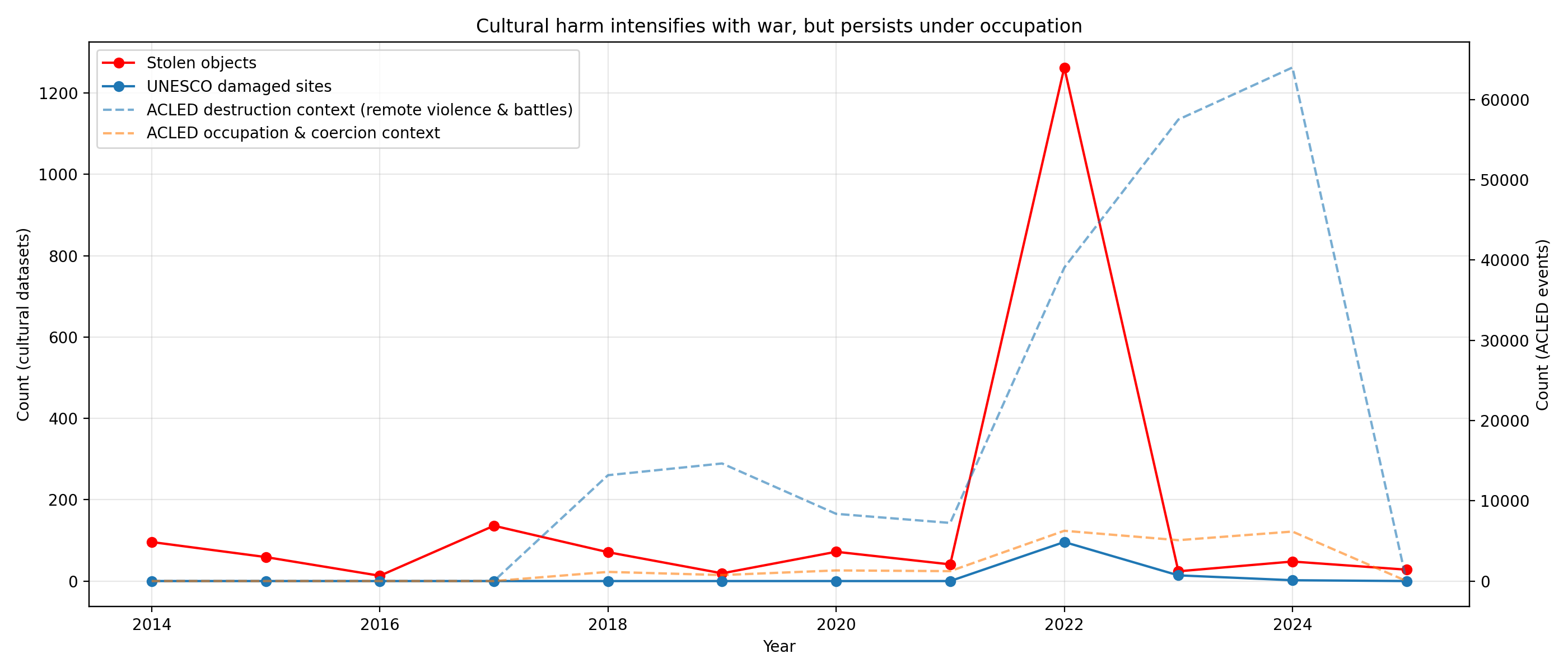
The timeline compares two cultural datasets—UNESCO damaged sites and stolen cultural objects—with two ACLED “contexts of violence”: a destruction context (Explosions/Remote violence + Battles) and an occupation & coercion context (Violence against civilians + Strategic developments). This separation reflects what emerged in the exploratory analysis: destruction is linked to high-intensity warfare, while looting appears more selective and tied to territorial control.
A clear structural break occurs in 2022, when both damage and looting intensify following the full-scale invasion. Yet the two phenomena diverge: damage to sites closely follows peaks in remote attacks and battles, while looting persists during phases associated with occupation, coercion, and strategic control. This suggests that not all cultural harm can be explained as collateral damage of combat alone.
2. Spatial patterns: warfronts vs. occupied territories
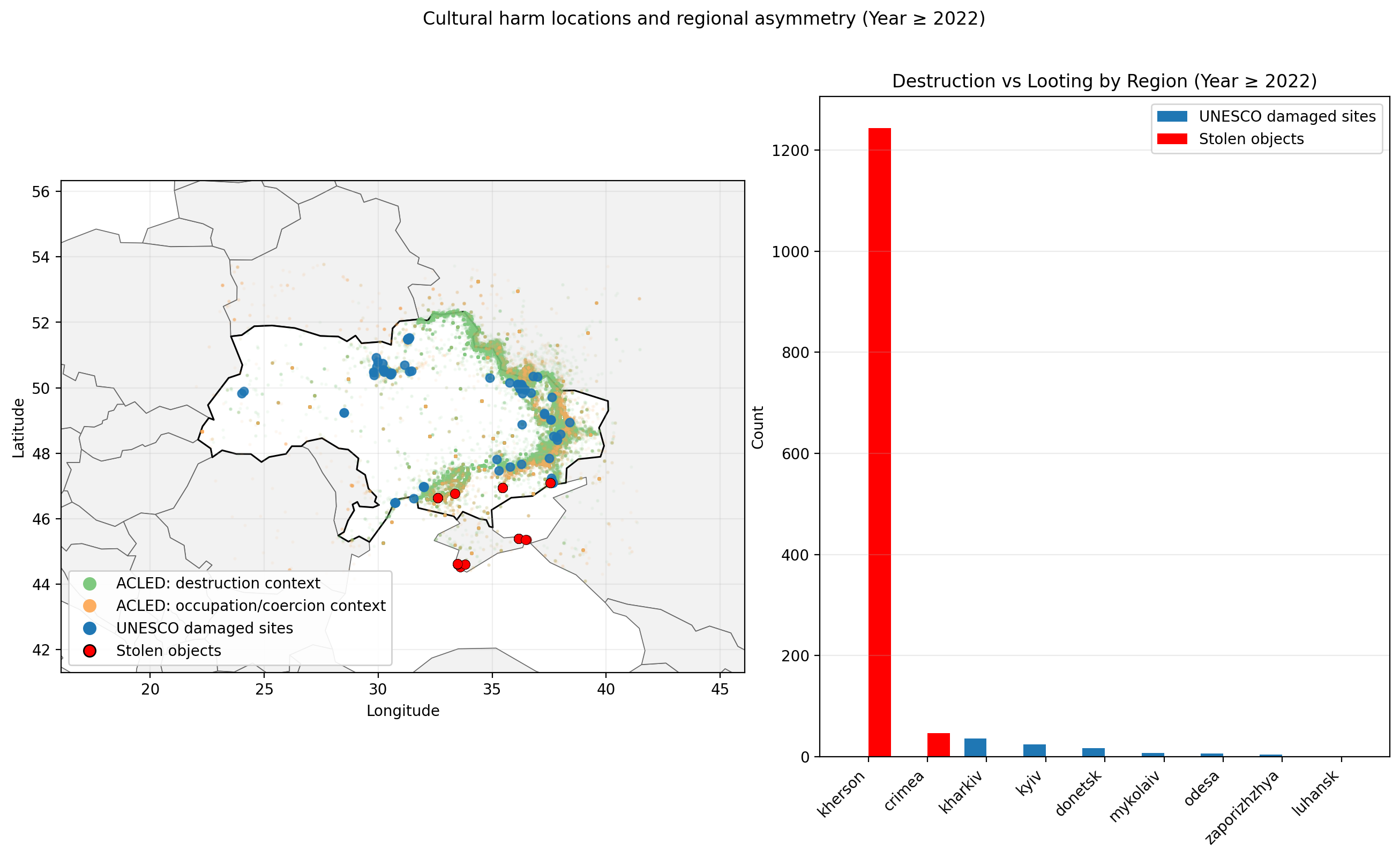
The spatial comparison reveals a strong regional asymmetry. Eastern regions such as Donetsk and Kharkiv concentrate many damaged cultural sites, while recorded looting is minimal—consistent with areas exposed to sustained frontline violence. In contrast, Kherson and Crimea show intense cultural appropriation with comparatively limited UNESCO-recorded destruction, reflecting prolonged occupation and stable territorial control.
The map overlay reinforces this distinction: damaged sites align with zones of remote violence and bombardment, while stolen objects cluster in occupied and coastal areas. In other words, destruction follows the logic of warfare, whereas looting follows the logic of control.
Damaged cultural sites form a continuous pattern along active frontlines, closely aligned with remote violence and bombardment. Destruction appears diffuse, systemic, and embedded in zones of sustained military pressure. Stolen cultural objects, by contrast, appear in localized and coastal clusters, particularly in southern Ukraine and Crimea. These clusters overlap primarily with ACLED events associated with occupation, violence against civilians, and strategic developments, rather than with direct combat.
Visually and analytically, looting emerges as a phenomenon of control, not of active warfare.
3. What gets damaged: heritage categories and historical layers
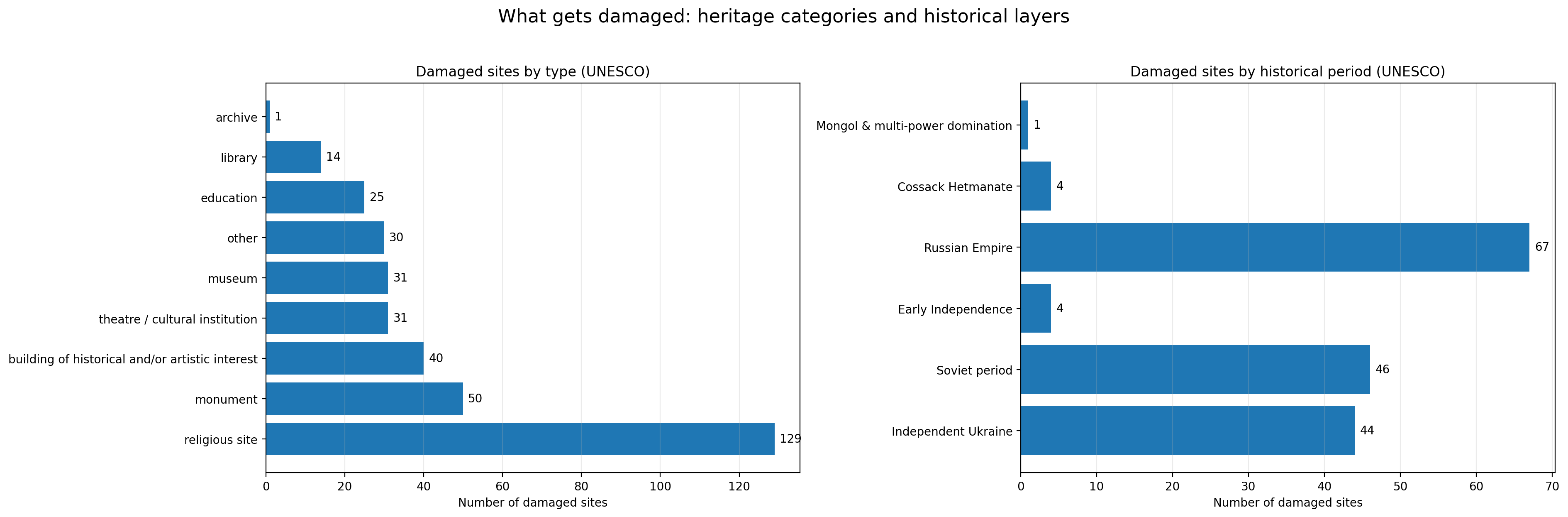
Beyond where and when cultural harm occurs, this visualization examines what is being damaged. UNESCO data show that damaged sites are predominantly religious buildings, followed by monuments and buildings of historical/artistic interest—high-visibility heritage that often anchors local identity and public memory.
Conclusion
Taken together, the temporal and spatial analyses point to a clear dual logic of cultural harm. The timeline highlights how the destruction of cultural sites intensifies alongside peaks of high-intensity military violence, particularly remote attacks and bombardment. At the same time, the spatial distribution shows that destruction concentrates along active frontlines, where cultural heritage is exposed to systemic military pressure.
Looting, by contrast, follows a different pattern. Rather than aligning with moments of direct combat, the removal of cultural objects persists during phases characterized by occupation, violence against civilians, and strategic control. Spatially, looting clusters in occupied and coastal regions, where stable territorial control enables practices of appropriation and coercion.
These two forms of cultural harm are therefore temporally, spatially, and operationally distinct, even though they unfold within the same conflict. While cultural destruction reflects the dynamics of warfare, cultural looting reflects the dynamics of control.
An open question remains: if destruction erases cultural spaces and looting removes cultural objects, do these practices together contribute to the systematic erosion of cultural identity? Rather than isolated acts, the combined patterns observed here suggest that cultural harm may operate across multiple dimensions of heritage, memory, and belonging.
How effective is international protection when cultural heritage is exposed to modern warfare?
In other words: does recognition translate into safety, or does it remain administrative?
This visualization compares UNESCO-protected heritage sites with documented damage events to reveal what gets recorded in official registers, and what remains invisible.
The main issue is a visibility mismatch: UNESCO lists are intentionally selective and reflect long-term heritage policies, while destruction reports refer to a much broader set of cultural entities exposed to violence. The result is a "protection gap", where a large share of documented damage concerns heritage that sits outside international recognition frameworks.
The waffle chart below offers a scale-comparable view of this discrepancy by juxtaposing UNESCO-listed sites (World Heritage and Tentative List) with cultural entities reported as damaged by Linked4Resilience, drawing on multiple monitoring sources, including UNESCO’s own damage reporting.
Each square represents one entity. Yellow squares correspond to UNESCO-listed sites, while blue squares represent damaged sites, many of which fall outside UNESCO's scope.
Filters allow users to isolate specific types of damaged sites (religious buildings, museums, libraries, or others), while UNESCO sites remain visible as a constant reference layer. This makes the imbalance immediately legible: international recognition covers only a fraction of what is being hit.
Hover on each square to explore individual sites, protection status and type of heritage. Use the category filters to spotlight specific groups of damaged sites.
However, even when a site is formally recognised, protection does not imply distance from harm. Damage can occur within a few hundred meters of protected cores, where shockwaves, debris, secondary fires, and structural stress may affect the broader historic fabric.
To quantify this exposure, we computed proximity between protected and damaged locations. For each UNESCO site with valid coordinates, we identified the nearest documented damage report, then grouped UNESCO sites by distance bands.
Methodologically, this is not a claim of causality (damage reports can reflect different kinds of events and documentation practices), but a way to transform risk into a measurable spatial relation expressed in meters.
The visualization below shows how many UNESCO sites have at least one recorded damage event within 250 m, 500 m, 1 km, and beyond.
This shifts the argument from lists and categories to spatial constraints: even UNESCO-protected sites can be exposed at short range, making the protection gap not only institutional, but also physical.
In the next step, we zoom into one of the most exposed cases and visualize the local pattern of nearby damage around a single UNESCO site.
Each UNESCO site is counted once, based on the distance to its nearest reported damage location. Distances are computed using geodesic distance between coordinates.
Bar charts provide a comparative overview, but they can still feel abstract. To make exposure tangible, we move from distribution to a single-site focus and map the spatial density of nearby damage events.
The case study focuses on the Historic Centre of Tchernihiv, which emerges as one of the closest-hit UNESCO cases in the dataset. This shift in scale helps connect institutional protection to the granular geography of conflict.
The plot below adopts a target-style layout: the UNESCO site is placed at the centre, while each dot represents a nearby damage report positioned by distance (meters) and arranged around the circle for readability.
Concentric rings mark reference distances (250 m, 500 m, 1 km). Colour encodes proximity: warmer tones indicate events closer to the protected core. The purpose is not to reconstruct trajectories of attacks, but to highlight how quickly the notion of safety collapses into a matter of a few hundred meters.
Hover the UNESCO symbol for site details; hover dots for the nearest damage reports and their distance from the centre. Rings mark 250 m, 500 m, and 1 km.
Cultural harm is not limited to the destruction of built heritage. The conflict has also intensified a parallel process: the looting of movable heritage objects and their potential circulation through illicit markets.
To interpret theft patterns, we align two different institutional lenses: ICOM's Red List, which defines typological categories considered especially vulnerable to trafficking during crises, and the dataset of reported stolen objects, which records individual artefacts documented as missing or expropriated.
The central methodological step is category reconciliation. Because the two sources were not designed to match one another, object descriptions in the stolen dataset are mapped onto the Red List's typological categories via rule-based normalization, producing a shared categorical space for comparison.
The chart below compares the relative shares of object categories across two different perspectives: the ICOM Red List, which expresses an institutional risk model through category emphasis, and the dataset of reported stolen objects, which reflects the empirical composition of documented theft cases.
Divergences between the two should be interpreted with caution. When reported theft exceeds Red List emphasis, looting may concentrate on categories that are underrepresented in institutional expectations, or reporting may be uneven across object types. In fact, where the Red List outweighs reported theft, the gap may point to effective prevention measures, limited documentation capacity, or underreporting of specific categories.
Each pair of bars contrasts the category emphasis in the ICOM Red List with the category composition of reported stolen objects.
The comparison highlights a clear mismatch between institutional expectations and reported theft. The ICOM Red List prioritises specific categories based on expert assessments of vulnerability, while the stolen objects dataset reflects what has been concretely removed under wartime conditions.
The two distributions do not overlap neatly. Categories that receive limited emphasis in the Red List account for a substantial share of reported theft, while some high-risk categories appear less frequently in documented cases. This suggests that actual looting practices respond to opportunity, availability, and ease of removal rather than to institutional definitions of risk alone.
At the same time, a large portion of stolen objects falls into mixed or residual categories, indicating that many artefacts circulate outside clearly bounded typologies. This complicates efforts to anticipate cultural loss through predefined taxonomies.
When considered alongside the limited coverage of international protection and the spatial proximity of damage to recognised heritage sites, this analysis reinforces a central finding of the project: cultural loss in Ukraine is only partially captured by existing institutional frameworks. What is targeted, damaged, or appropriated often exceeds the categories through which risk and protection are formally articulated.
Across different historical periods, Russia has repeatedly engaged in practices of cultural appropriation affecting Ukrainian heritage. From the Russian Empire to the Soviet Union, mechanisms of extraction were progressively normalized through institutional frameworks such as centralized museum policies, large-scale archaeological campaigns, and narratives of preservation that justified the relocation of cultural objects away from Ukrainian territory.
During the Soviet period, these practices became structural. Cultural removal was embedded in state institutions and presented as conservation, scientific research, or cultural unification. In the contemporary context, similar dynamics persist under radically different conditions. The ongoing war has stripped these practices of any politically neutral justification, exposing cultural appropriation as part of a broader conflict rooted in colonial narratives that deny Ukraine's cultural and historical autonomy.
This raises an initial question:
Where does cultural harm begin — with military destruction, or with long-term
appropriation?
Despite the existence of international treaties prohibiting the destruction and looting of cultural heritage, notably the 1954 Hague Convention, global governance mechanisms remain limited. Institutions such as UNESCO play a crucial role in documentation and monitoring, but they lack legislative or judicial power. While some restitution processes have succeeded internationally, no stable and enforceable international protocol currently exists to regulate restitution and protection during active conflicts.
What does protection mean, if it cannot prevent destruction?
And in this context, who is responsible for safeguarding cultural heritage when
international law proves insufficient?
Within this framework, our analyses highlight a dual logic of cultural harm. The destruction of cultural sites intensifies alongside peaks of high-intensity military violence and concentrates along active frontlines.
Looting, by contrast, follows the logic of occupation and control: the removal of cultural objects persists outside direct combat phases and clusters in occupied and strategically controlled regions.
These two forms of cultural harm are therefore temporally, spatially, and operationally distinct, even though they unfold within the same conflict. While destruction reflects the dynamics of warfare, looting reflects the dynamics of domination and appropriation.
If destruction erases cultural spaces and looting removes cultural
objects,
what remains of cultural identity once heritage is fragmented, displaced, or
reclassified?
This leads to a broader and more difficult question:
can these practices be understood as cultural genocide?
In international legal and scholarly debates, cultural genocide,
distinct from the term genocide,
refers to processes aimed at the systematic destruction of a group's cultural
foundations, including monuments, symbols, memory, and identity.
Demonstrating cultural genocide is particularly complex, as it requires evidence of
intentionality:
the deliberate aim to erase or replace a culture.
In the Ukrainian case, while this project does not claim to legally establish cultural genocide, some patterns are difficult to ignore. The repeated targeting of cultural symbols, the systematic theft and reclassification of heritage, and the explicit denial of a distinct Ukrainian identity suggest a strategy that extends beyond territorial control.
When cultural destruction, looting, and forced assimilation
converge,
is it still sufficient to speak of damage, or are we witnessing a process of
cultural and identity erasure?
Rather than offering a definitive answer, this project proposes an evidence-based foundation for further inquiry. The question remains open, and its implications extend far beyond Ukraine.
The people behind
the research
Virginia D'Antonio
virginia.dantonio@studio.unibo.it
Catalina Salguero
catalina.salguero@studio.unibo.it
Elena Binotti
elena.binotti2@studio.unibo.it